
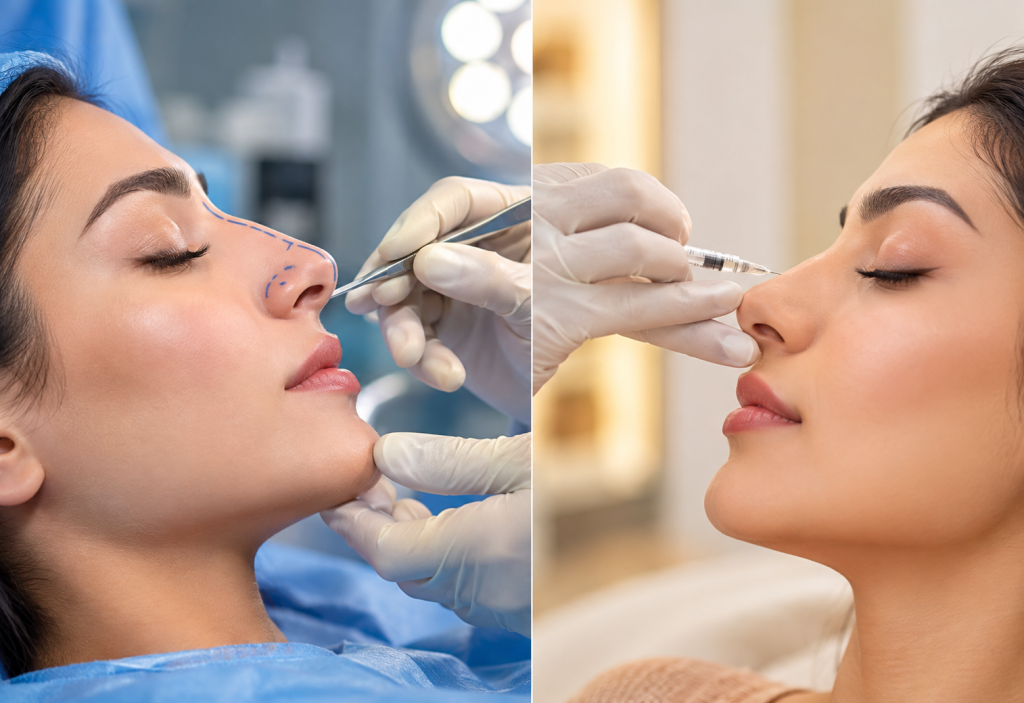
When you are unhappy with the shape, size, or proportions of your nose, the first question is often not “Should I change it?” but “What kind of treatment do I actually need?”
Some people want a permanent structural change. Others simply want to smooth a bump, improve symmetry, or make the nose look more balanced without undergoing surgery. This is where the choice between rhinoplasty vs non surgical nose job becomes important.
Both approaches can change the appearance of the nose, but they work in very different ways. Understanding what each procedure can and cannot achieve is essential before making a decision.
What Is Rhinoplasty?
Rhinoplasty is a surgical procedure used for nose reshaping. Depending on the individual’s anatomy and goals, surgery can modify the bone, cartilage, and soft tissue of the nose.
Rhinoplasty may be considered when someone wants to:
- Change the overall shape or size of the nose
- Reduce or modify a nasal hump
- Refine the nasal tip
- Improve nasal proportions
- Correct certain structural irregularities
- Address functional concerns affecting breathing
Because rhinoplasty involves structural changes, its results are intended to be long-lasting.
However, surgery also means a more involved recovery period. Swelling and bruising are common after the procedure, and the final appearance may take time to become fully apparent.
What Is a Non Surgical Nose Job?
A non surgical nose job, often called a liquid rhinoplasty, uses injectable filler to temporarily alter the appearance of the nose.
Instead of removing or surgically reshaping tissue, filler is strategically placed to create smoother contours and improve visual balance.
Liquid rhinoplasty may be used to:
- Make a nasal bump appear less prominent
- Create a smoother nasal profile
- Improve minor asymmetry
- Add definition to certain areas
- Create subtle changes in nasal proportions
The important distinction is that fillers add volume. They do not remove bone or cartilage.
That makes liquid rhinoplasty useful for certain cosmetic concerns, but it also creates clear limitations.
Rhinoplasty vs Non Surgical Nose Job: Key Differences
The biggest difference between the two procedures is how the nose is changed.
| Factor | Rhinoplasty | Non Surgical Nose Job |
| Treatment | Surgical | Injectable |
| Structural changes | Yes | No |
| Removes tissue | Can | No |
| Adds volume | Can be part of treatment | Yes |
| Permanence | Long-lasting | Temporary |
| Recovery | More involved | Generally shorter |
| Ability to reduce nose size | Yes | No |
| Ability to correct certain structural concerns | Yes | Limited |
The right option depends less on which procedure is more popular and more on what you want to change.
When Rhinoplasty May Make More Sense
If your goal requires actual structural modification, rhinoplasty may be the more appropriate approach.
For example, someone who wants to significantly reduce the size of their nose cannot achieve that by simply adding filler. Similarly, correcting certain structural problems may require surgical intervention.
Rhinoplasty may also be considered when the desired change is substantial rather than purely cosmetic and subtle.
Think Beyond the Front View
A common mistake is judging the nose only from a front-facing photograph.
The nose affects the overall balance of the face from multiple angles. A change that looks attractive from the front may not produce the same effect from the side or three-quarter view.
A proper consultation should therefore consider facial proportions, nasal structure, skin characteristics, and the individual’s desired outcome rather than focusing on a single feature.
When a Liquid Rhinoplasty May Be Considered
A liquid rhinoplasty can be an option for people looking for a temporary nose reshaping approach and whose concerns are suitable for filler-based correction.
For example, strategically placed filler may make a dorsal hump appear less noticeable by creating a smoother profile.
This can sound counterintuitive: if filler adds volume, how can it make a nose look straighter?
The answer is visual contouring. By adding volume around an irregularity, the transition between different parts of the nose can appear smoother.
However, this does not mean the underlying hump has been removed.
Rhinoplasty Alternatives Have Limitations
The term rhinoplasty alternatives can make non-surgical treatments sound interchangeable with surgery. They are not.
A non-surgical approach cannot reproduce every result that surgical rhinoplasty can achieve.
For instance, filler cannot physically remove excess cartilage or bone. It also cannot make a nose smaller by removing tissue.
This is why treatment selection should begin with the problem being addressed rather than the procedure itself.
If someone wants a subtle contour adjustment, a temporary approach may be discussed. If they want a major structural change, surgery may be more appropriate.
Recovery and Longevity
Recovery is another major consideration when comparing rhinoplasty vs non surgical nose job.
Surgical rhinoplasty generally requires more downtime, and swelling can continue changing the appearance of the nose for an extended period as healing progresses.
Liquid rhinoplasty typically involves much less downtime, but its effects are temporary because the injected filler is eventually absorbed by the body.
This creates an important trade-off:
Surgery offers structural and long-lasting change, while liquid rhinoplasty offers temporary contour modification with a less involved treatment process.
Neither characteristic automatically makes one option suitable for everyone.
Is a Non Surgical Nose Job Safer?
It is easy to assume that a treatment is risk-free because it does not involve surgery. That assumption is incorrect.
The nose contains important blood vessels and has a complex anatomy. Injectable treatments therefore require appropriate anatomical knowledge, careful technique, and proper patient selection.
Similarly, rhinoplasty is a surgical procedure with its own potential risks and recovery considerations.
The safest approach is not to choose a procedure based solely on the word “non-surgical.” Instead, discuss your goals, anatomy, medical history, and expected results with a qualified medical professional.
How Do You Choose Between the Two?
Start by asking three practical questions:
1. What exactly do I want to change?
If you want a subtle contour adjustment, a non-surgical approach may be discussed.
If you want to reduce, reshape, or structurally modify the nose, surgical rhinoplasty may need to be considered.
2. Do I want a temporary or long-term result?
Liquid rhinoplasty provides temporary results. Rhinoplasty is intended to create longer-lasting structural changes.
Your preference for longevity can therefore influence the decision.
3. How much change am I expecting?
Small aesthetic adjustments and major structural transformations are very different treatment goals.
Being realistic about the amount of change you want is one of the most important parts of the consultation process.
Rhinoplasty vs Non Surgical Nose Job: The Bottom Line
There is no universal answer to the question of rhinoplasty vs non surgical nose job.
Rhinoplasty can physically reshape the nasal structures and is suited to goals that require more significant or permanent structural changes. A non surgical nose job or liquid rhinoplasty uses filler to create temporary changes in contour and proportion, making it relevant for selected concerns that do not require tissue removal or major structural modification.
The key is to match the treatment to the problem—not choose a procedure simply because it appears less invasive or more convenient.
If you are considering nose reshaping, a detailed consultation can help determine whether surgical rhinoplasty, liquid rhinoplasty, or another approach is appropriate for your individual anatomy and aesthetic goals.